How Much Does a Company Website Cost? The Factors That Decide the Price
Quotes for a company website can vary widely. Learn what drives the price and the running costs that are often forgotten before you choose a quotation.
Read the article →
Many B2B companies already have a website, but the articles section is empty or was last updated years ago. Yet articles are an effective way to appear on Google when potential customers are looking for information, while showing that your company knows its field.
Writing articles for a company website doesn't have to be complicated. You don't need to be a professional writer. What you need is the right topics, a clear structure and the habit of writing regularly. This article explains the steps.
B2B buyers usually do their research before contacting a supplier. They look into differences between materials, specifications, production processes or how to choose a vendor. If your website answers those questions, your company is present from the start of the search, before potential customers draw up their supplier shortlist.
Articles also help your sales team. Frequently asked questions only need answering well once, and the link can then be shared with potential customers. Questions with short answers are better collected on an FAQ page.
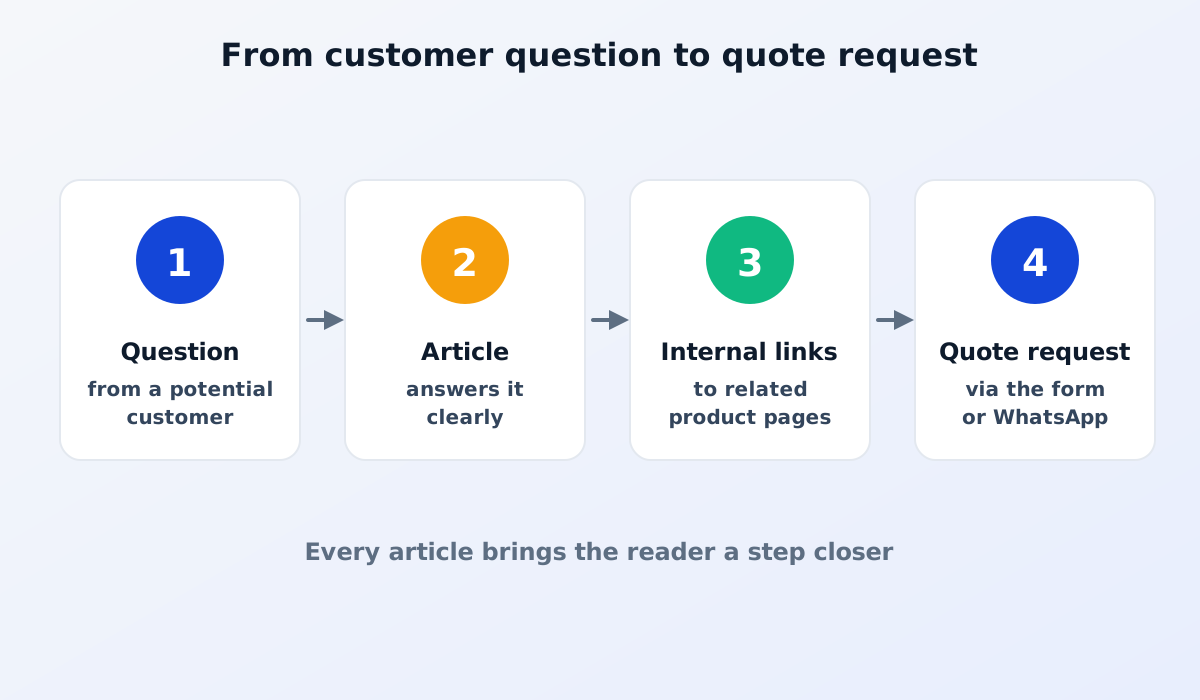
The best source of topics isn't guesswork but the real questions your company receives. Gather them from:
Example topics for a packaging manufacturer: "the difference between single-wall and double-wall cardboard", "how to choose the right box size for shipping" or "what to prepare before ordering custom packaging". Topics like these are specific, searched for and close to the buying decision. How to turn customer questions into a plan of pages is covered in keyword research for B2B businesses.
Each article should focus on answering one main question. An article that tries to cover everything at once is usually too long, hard to read and unlikely to appear for specific searches.
If a topic is too broad, split it into several articles that link to each other. Also avoid writing several articles about almost the same thing, as they will compete with each other on Google.
People rarely read a web page word for word. They scan the headings and look for the relevant section. A helpful structure:
Use language your customers understand. Technical terms are fine, but explain what they mean the first time they appear.
An article doesn't stand alone. Add links to related product or service pages, and to other articles on related topics. Internal links help readers move on to the next piece of information, and help Google understand which pages on your website matter most.
The end goal is to take readers from their question to the relevant page, and then to the contact or quote request form.
Read also: how to get your company website on Google.
Consistency matters more than volume. One or two well-written articles a month are more useful than ten at once followed by months of silence.
Decide who writes, who checks the technical content and when articles are published. At a manufacturing company, the writer could be in the marketing team, while the content reviewer comes from production or engineering.
If your website's CMS supports scheduling, write several articles at once when you have time, then set their publication dates one by one. Each article goes live automatically on its set date, so your website stays active even when the team is busy.
Read also: what a CMS is to understand how to manage your own website content.
There is no fixed number. Write as much as you need to answer the question fully, without padding. For technical B2B topics, articles are usually fairly long because they need to explain the details.
Yes, especially when the information has changed, such as product specifications or regulations. Updating an article that already gets visits is often more effective than writing a new one.
It depends on your market. If your company serves buyers abroad, articles in English help them find and understand your products. Start with the topics overseas buyers ask about most. Read also a multilingual website for manufacturers.
The best article for a B2B website is a good answer to a question your customers already ask often.
Need a website with a CMS that makes it easy to write and schedule articles? See our website services.
Quotes for a company website can vary widely. Learn what drives the price and the running costs that are often forgotten before you choose a quotation.
Read the article →
When a company website needs a redesign, and how to move to a new site without losing Google rankings: content inventory, 301 redirects and Search Console.
Read the article →