Company Website Security: The Basics You Need to Have in Place
The basic steps for keeping a company website secure: HTTPS, regular updates, strong passwords and 2FA, user access rights, backups and protection from spam.
Read the article →
When you look for a company to build your website, you may receive quotes that are miles apart: some for a few million rupiah, others for tens of millions. Both can be perfectly reasonable. The difference lies in what is included, and in how much you still have to pay once the website is finished.
This article covers the factors that decide what a company website costs, the running costs that are often forgotten, and how to compare quotations fairly.
A simple company profile website usually has a handful of pages: home, about us, services and contact. A product catalogue website is much larger, because every product, category or industry can have its own page.
The more pages and types of content, the more design, development and content work is involved. So before asking for a quote, prepare a rough estimate: how many main pages you need and how many products will be shown.
A ready-made template is cheaper and faster, but your website may look like many others. A custom design is built around your brand identity, so it looks more professional and stands apart from your competitors.
Custom design takes more time and money because it goes through design, revision and refinement. For companies that sell to business customers, a professional look is often the first impression that decides whether a prospect gets in touch.
A website with a CMS (Content Management System) lets your team change products, articles and pages themselves without a developer. Building a CMS that is easy to use takes extra work, but over time it usually saves money because you don't pay every time you need a small change.
See also: What is a CMS and why does a company website need one.
Some features that affect the cost:
Make sure you only pay for the features your business actually needs now. A well-built website can be extended in stages, so other features can be added when they are genuinely needed.
Who puts the text, photos and product data into the website? This work is often underestimated, yet for a catalogue with dozens of products it can take days. Some quotes include the initial content entry and some don't. Ask clearly, including any limit on the number of products or pages that will be entered.
The price of building a website is only the up-front cost. Some costs come back every month or every year:
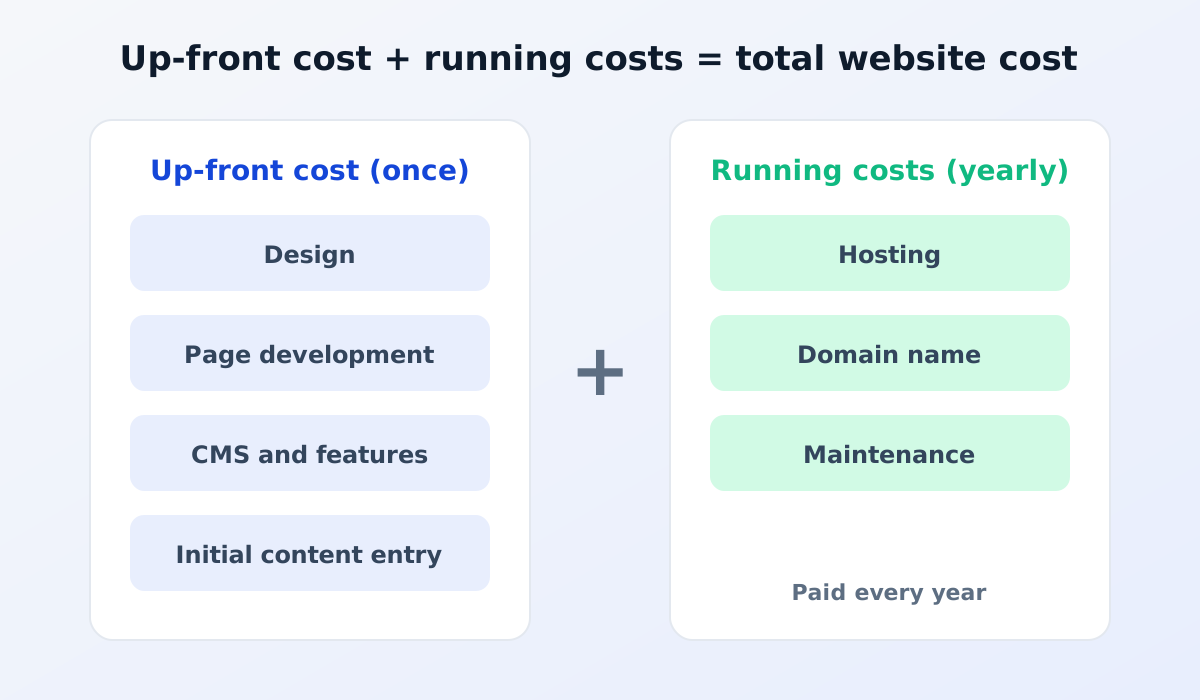
A quote that looks cheap at the start can become expensive if the running costs are high. On the other hand, a quote that already includes hosting and maintenance can work out cheaper overall. The fairest way to compare is to add up the total cost for the first one or two years, not just the up-front price.
To make this easier to picture, here are three common needs and the work they usually involve:
A few pages about the company, its services and how to get in touch, with a clean design and a simple form. Suits service companies that want to look professional when prospective customers look them up. If all you need is one page for an ad, read landing page or company website.
Product, category and industry pages that your team can update themselves, often in more than one language. There is more work involved because it covers the catalogue structure, the CMS and entering product data.
On top of the catalogue, there is a shopping basket, payments and shipping. This is the most complex need and usually requires more intensive maintenance.
A website is not a once-in-a-lifetime purchase. Technology, the way people search for information and your business needs all keep changing. A well-built website that is maintained regularly can last for years with just content updates and small adjustments.
There are, however, signs that a website needs rebuilding: it looks broken on mobile, it is very slow to load, it is hard to update, or it no longer reflects your business today. If you see several of these signs, rebuilding on the right foundations is often cheaper than continuing to patch up the old website.
There are website builders you can use yourself for a monthly fee. They suit simple needs. But for a company website with a catalogue, several languages and a look that fits your brand, the time your team spends often costs more than a professional service.
Many providers use staged payments tied to the stages of the work. Ask about the payment schedule early on so it fits your company's budget.
Usually not. Advertising on Google, Meta or TikTok is paid directly to those platforms. What a website provider can set up is the tracking, so the results of your ads can be measured.
The best quote isn't the cheapest one but the clearest one: you know exactly what you get, what it costs now and what it will cost next year.
If you are comparing quotations, also read how to choose a web design company.

The basic steps for keeping a company website secure: HTTPS, regular updates, strong passwords and 2FA, user access rights, backups and protection from spam.
Read the article →
Why your company should use email on its own domain, the service options, and a plain-English guide to SPF, DKIM and DMARC so your emails stay out of spam.
Read the article →