How Much Does a Company Website Cost? The Factors That Decide the Price
Quotes for a company website can vary widely. Learn what drives the price and the running costs that are often forgotten before you choose a quotation.
Read the article →
There are plenty of web design providers in Jakarta and Tangerang, from freelancers to large agencies. Prices and quality vary widely, and from the outside they all look convincing. The checklist below helps you choose the right provider for your company, so the website you get is genuinely useful and doesn't cause problems later on.
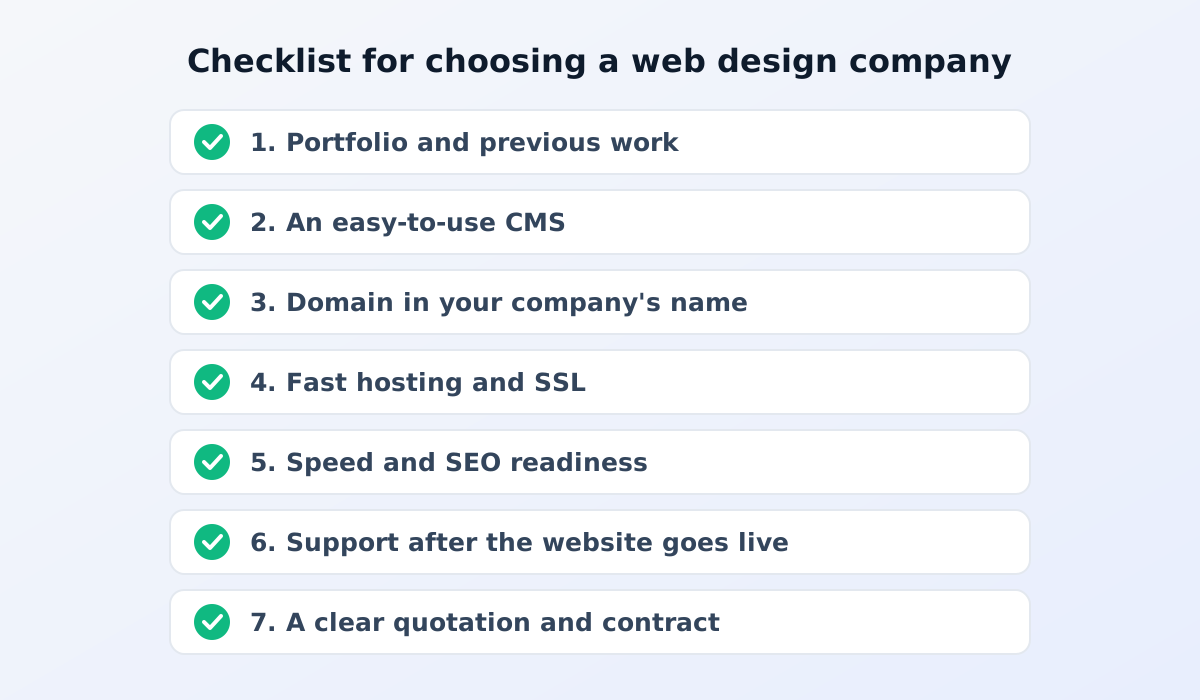
Ask for examples of websites they have built, then open them on your phone. Check whether they look tidy, load quickly and are easy to use. A website that looks good on a large screen isn't necessarily comfortable on a phone, even though most visitors arrive on a phone. See also what often gets missed on a phone.
If possible, also ask about previous clients' experience: did the project finish on time, and what was the service like after the website went live?
Ask whether the website comes with a CMS. Without a CMS, every small change, such as replacing a product photo or adding an article, has to be done by a developer. That takes time and money, so the website ends up rarely being updated.
Ask for a demo of the CMS. Make sure your team can understand it without complicated training, and ask whether there is a short training session once the website is finished.
The domain name is your website's address. Make sure it is registered in your company's name, not the provider's. If you ever change provider, the website address stays yours, and so does the reputation you have built up on Google.
A website needs to be hosted on a fast, stable server with an SSL certificate (the padlock in the browser). Ask:
A slow website drives visitors away and can lower your position on Google. Ask whether every page can have its own title and description, and whether a sitemap is generated automatically. These basics help your website get found in search.
You can also test the speed of their example websites with a free tool such as Google's PageSpeed Insights.
The work doesn't end when the website launches. Make sure it is clear:
A good quotation sets out the scope of work, the number of pages, the revision limit, the estimated timeline and the payment schedule. Staged payments, for example up front, on design approval and at launch, protect both sides. For what the contract itself should include, read website development contracts.
All three can be good choices, depending on your needs:
Working with a provider in Jakarta or Tangerang makes face-to-face meetings easy, especially at the start when you discuss requirements and design. That said, much of the process of building a website now runs smoothly online through video calls and screen sharing. What matters most is clear communication and a schedule agreed from the start.
Building a company website usually goes through several stages: a consultation on requirements, design, development, content entry, a joint review, then launch. For a company website with a CMS, the whole process generally takes a few weeks.
The stage that most often delays a project isn't the technical work but having the content ready: text, photos and product data. So start preparing your material early.
The more complete your material, the faster and more accurate the result.
A good provider doesn't mind answering every question above. If the answers are vague, that is your answer.
Want to know what affects the price? Read how much a company website costs.
Quotes for a company website can vary widely. Learn what drives the price and the running costs that are often forgotten before you choose a quotation.
Read the article →
The basic steps for keeping a company website secure: HTTPS, regular updates, strong passwords and 2FA, user access rights, backups and protection from spam.
Read the article →